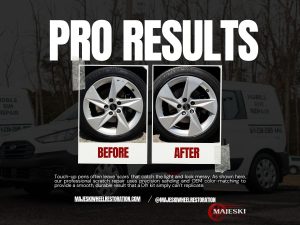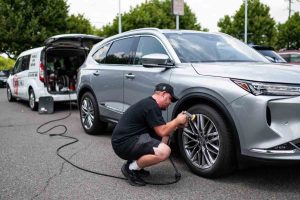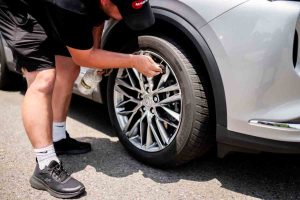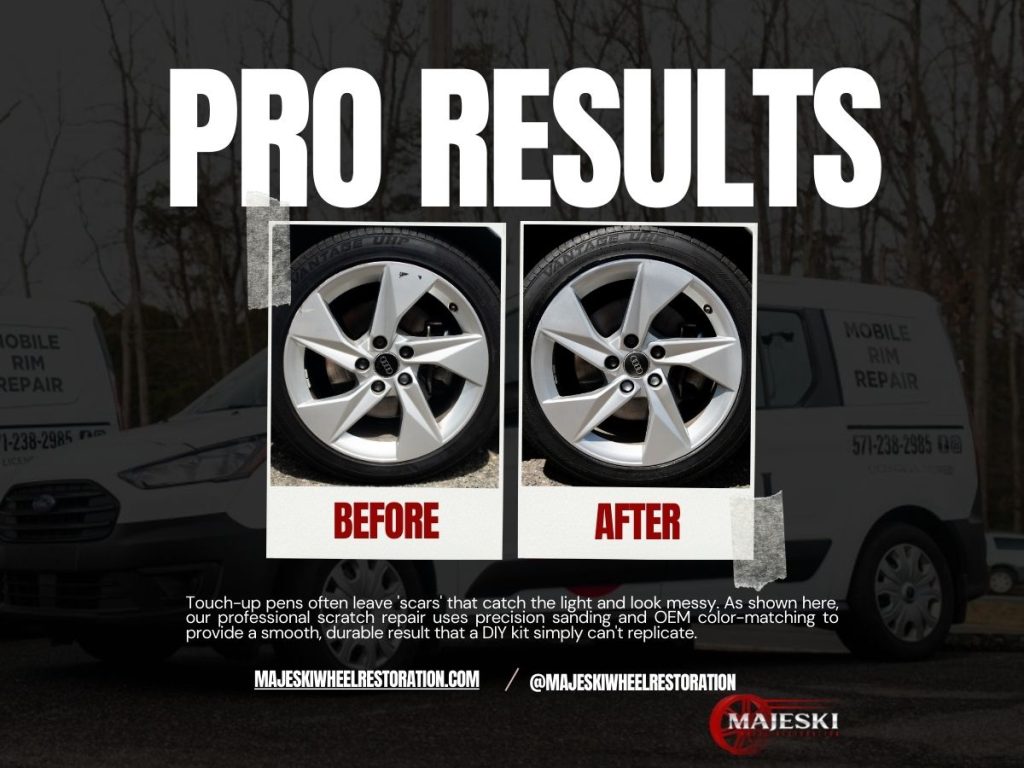
When that “jagged silver scar” first appears on your alloy wheels, your first instinct might be to grab a “quick fix” touch-up pen or a DIY repair kit from the local auto parts store. However, as the visual evidence shows, there is a massive gap between a “patch job” and a professional restoration.
At Majeski Wheel Restoration, we frequently spend our days stripping away these DIY attempts. Here is the technical reality of why those kits usually do more harm than good, and why professional service is the only way to achieve that seamless OEM look.
The Technical Reality of the “Bad Match”
Consumer-grade kits are designed for convenience, not for the complex metallurgy of modern luxury wheels. Here are three reasons they fail to match the results seen in our professional portfolio:
1. The Paint Chemistry Mismatch
Most luxury wheels feature a multi-stage finish: primer, a specific metallic base, and a high-solid clear coat. Touch-up pens are typically a “one-step” acrylic. They cannot replicate the depth or the “flip” (how light reflects) of an OEM finish. The result is often a dull, gray “scab” that stands out more than the original scratch.
2. Inferior Fillers and Adhesion
Professional restoration involves specialized aluminum fillers that bond at a molecular level. DIY kits often use generic “Bondo” style putties. These are prone to shrinking or popping out entirely when exposed to the extreme heat generated by your vehicle’s braking system.
3. Lack of UV and Chemical Protection
Automotive clear coats are engineered to withstand UV rays and corrosive brake dust. The “clear” included in retail kits is often thin and lacks protective stabilizers, leading to yellowing or peeling within just a few months.
The High Cost of a “DIY Mess”
It’s a common misconception that a DIY attempt is “worth a shot” because you can always call a pro later. In reality, a botched DIY job usually increases the final repair bill:
- Increased Labor for Strip-Downs: We can’t just paint over hardware-store putty. We must chemically strip the wheel or sand away contaminated layers to reach a clean surface, adding significant labor time.
- Safety Hazards: Kits encourage you to “fill and paint” without inspection. Our technicians check for hairline cracks or structural compromises that a DIY filler might hide, a major safety risk on the highway.
Professional vs. DIY: At a Glance
| Feature | DIY Touch-Up Kit | Professional Restoration |
| Color Match | “Universal” Silver (Rarely matches) | Custom-mixed OEM matching |
| Durability | Prone to peeling and yellowing | Heat-resistant, factory-grade |
| Surface Texture | Rough, “blobby,” and visible | Seamless and smooth-to-the-touch |
| Resale Value | Can decrease value (looks cheap) | Restores “like-new” trade-in value |
Frequently Asked Questions
Can I use a touch-up pen just to prevent rust?
Alloy wheels are aluminum, so they don’t “rust” like steel, but they do oxidize. Using a pen without proper decontamination traps moisture and brake dust against the metal, which actually accelerates “white spidering” corrosion.
Is professional repair really more cost-effective?
When you factor in the cost of the kit, your time, and the likely “second repair” when the DIY fails, professional mobile service is the smartest investment. We bring the shop to you, saving you time and ensuring the job is done right the first time.
Invest in Your Image
Your wheels are one of the most visible parts of your vehicle. A poor DIY repair signals to future buyers that the vehicle hasn’t been maintained to a high standard. By choosing professional wheel scratch repair, you ensure your car continues to look the part.
Have you already tried a DIY fix that didn’t go as planned?
Or do you have fresh damage you want handled the first time?
Click here to schedule a professional assessment at your home or office!