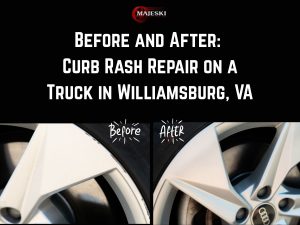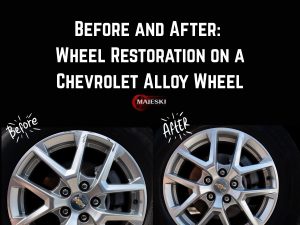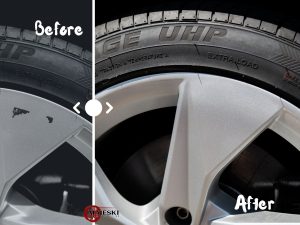
When it’s time to trade in your vehicle or list it for a private sale, every detail counts. While you might focus on the engine or the interior, appraisers are looking lower, at your wheels. In this post, we’ll explore how curb rash impacts your bottom line and why professional restoration is often the highest-ROI move you can make.
In the competitive car markets of Williamsburg and the surrounding areas, first impressions are everything. To a buyer or a dealership appraiser, scarred rims aren’t just an eyesore; they are a red flag for how the vehicle was maintained.
At Majeski Wheel Restoration, we’ve seen how a few hundred dollars in wheel curb rash repair can translate into thousands of dollars in added resale value.
The Appraiser’s Perspective: Cosmetic vs. Structural
When a dealership appraises your car for a trade-in, they use a “reconditioning” deduction. This is the amount of money they subtract from your car’s value to get it “front-line ready.”
Cosmetic Curb Rash
Scrapes along the outer lip of the rim are immediately visible. An appraiser assumes that if the driver wasn’t careful with the curbs, they might not have been careful with other maintenance. Most dealerships will deduct $150-$300 per wheel for cosmetic damage, even if the actual curb rash cost to fix it is lower.
Structural & Mechanical Damage
If the appraiser spots a bend or a deep gouge that suggests a heavy impact, they worry about suspension health and wheel bearings. This can trigger a much deeper deduction or even a “wholesale” offer rather than a “retail” trade-in value. Understanding different rim repair types is essential before you walk onto the lot.
The 3 Levels of Curb Rash Repair
Not all damage is created equal. At Majeski, we categorize your damage to find the most cost-effective alloy wheel restoration solution.
Level 1: Surface Scuffs (The “Clear Coat” Fix)
These are light scratches that haven’t reached the metal.
- The Fix: We sand the clear coat and polish the area to a factory shine.
- ROI: Extremely high. This is a fast fix that removes a major “visual negative” for buyers.
Level 2: Standard Curb Rash (Metal Displacement)
The curb has actually “chewed” into the aluminum, leaving a jagged edge.
- The Fix: Our mobile technicians sand the metal smooth, use metallurgical fillers if necessary, and perfectly match the OEM paint.
- ROI: This is the “sweet spot” for resale. It restores the wheel’s silhouette so it looks brand new in listing photos.
Level 3: Deep Gouges and Chunking
Significant portions of the metal are missing or the rim lip is deformed.
- The Fix: This requires professional building up of the metal and a full refinish.
- ROI: Necessary. Leaving this damage on a vehicle usually results in a trade-in deduction far exceeding the cost of the repair itself.
Frequently Asked Questions
Should I use a DIY touch-up pen before selling?
We advise against it. Appraisers can spot “bottled” touch-up paint instantly. A botched DIY job often looks worse than the original scratch, leading the appraiser to wonder what else you tried to “fix” yourself.
Will I get my money back on the repair?
In almost every case, yes. Professional wheel repair in Williamsburg pays for itself by preventing “reconditioning” fee markups from dealers and by making your car stand out in private listings.
Invest in the Finish, Save the Sale
Curb rash is one of the few vehicle flaws that is 100% visible and 100% fixable. By addressing these imperfections before you list your car, you protect your resale value and ensure a faster, more profitable sale.
Are you preparing to sell or trade in your vehicle?
[Click here to get a free estimate] and let Majeski maximize your car’s value with professional, on-site curb rash repair!